
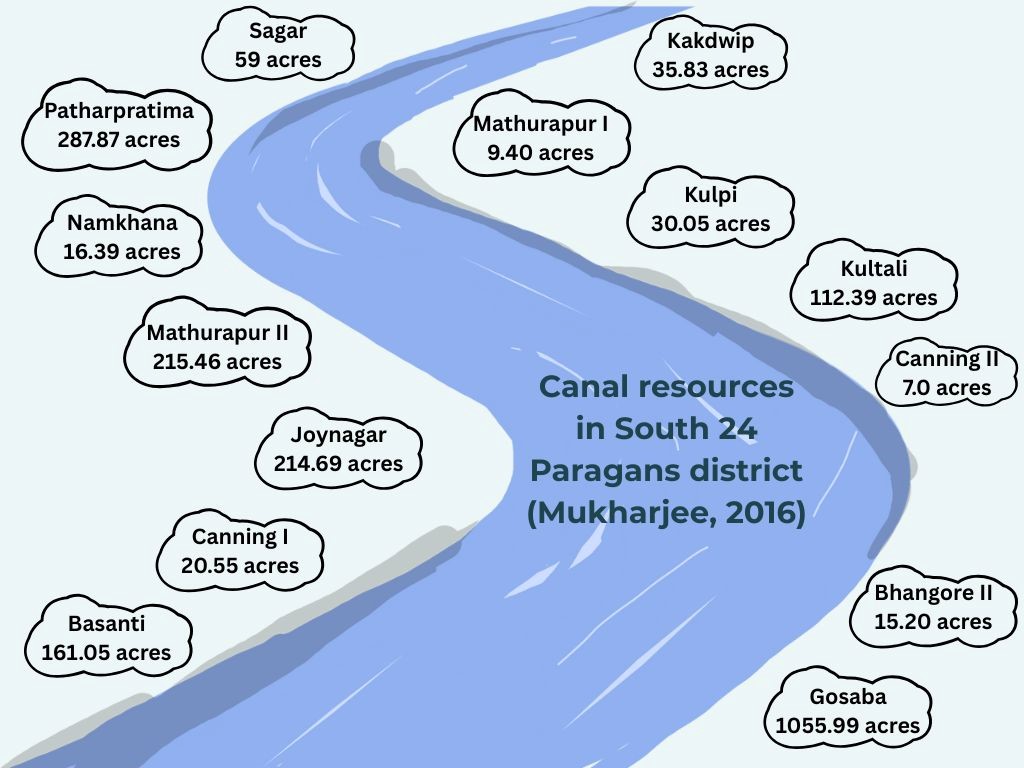
Total Canal area in West Bengal is 0.80 lakh ha (Mahapatra et al., 2015)

Biotic Communities
The assemblage of biotic community indicates the productivity of water body. Phytoplankton population, the biological wealth of an aquatic ecosystem (Boyd, 1972), responsible for wide assemblage of biotic community and regulate the food web (Falkowaski et al., 2008). Zooplankton, being the primary consumer in food chain, plays an important role in transfer of energy to the higher trophic level. Zooplankton is also fed upon by many juvenile and adult zooplanktivorous fish species (Sommer et al., 2003) and hence it can be termed a key factor in the control of fish stock sizes (Payne and Rippingale, 2001). The occurrence of these organisms largely depends on the seasonal variations of physico-chemical parameters, physiographic factors and flow characteristics of the water body.
Phytoplankton and zooplankton populations in the selected canals exhibited significant seasonal variations in their abundance. Cyanophyceae excelled as a major microfloral component (>35%) followed by Bacillariophyceae (>28%) and Chlorophyceae (>17%). Other algal groups (Coscinodiscophyceae, Euglenophyceaea, Trebouxiophyceae, Mediophyceae, Xanthophyceae, Conjugatophyceae, Synurophyceae) contributed partially and fluctuated much in different seasons. Dinophyceae contributed least (<1%) proportion to the algal community. Diatoms were the most diverse group across the seasons in these canals. Compositions of zooplankton represented; Crustacean nauplius > Rotifera > Copepoda > Copepod eggs > Cladocera > Ostracoda in the stated order. Richness (Margalef, 1958) and Shannon-Weiner diversity index (Shannon, 1949) with a calculated value >2.95 in the studied canals indicated moderately rich phytoplankton diversity in the systems. Similarly, Pielou’s evenness index (Pielou, 1977) was also calculated with a mean value 0.88 showing an evenly spatial distribution of phytoplankton in the canals being studied.
Periphyton is the heterogeneous group of community assemblage being attached in plants, woods, stones and various other substrates. It has great importance as primary producers together with phytoplankton and macrophytes (Sing et al., 2002) which provides foods to many aquatic organisms. The periphytic associations in the selected canals of Sunderbans showed the dominance of six groups which represented as Bacillariophyceae > Cyanophyceae > Coscinodiscophyceae > Chlorophyceae > Conjugatophyceae > Nematoda. Diatoms invariably constituted the bulk of the population (> 66%) of the total periphytic community attached with the natural substrates. Macrobenthos such as Pila virens, Bellamya bengalensis, Pila globossa, Meiniplotica scabra, Tarebia granifera and Thiara lineata were very common, irrespective of seasons, in the selected canals.
Small indigenous fishes (SIFs) are the major catch in these canals contributing more than 75% (percentage shown on the basis of studied canals) of the total catch. Amblypharyngodon mola, Puntius sophore, Pethia ticto, Parambassis ranga, Chanda nama, Trichogaster spp., Anabas testudineus, Macrognathus pancalus, Glossogobius giuris, Channa punctata, C. marulius, Salmophasia bacaila, Notopterus notopterus, Mystus gulio, Mystus spp. Chelon parsia, C. tade were the major catch. Penaied and non-penaied prawns also contributed a good amount of share (<10.0%) to the total fish catch.
Exploration of canal resources as a potential source for fish production in the Indian Sunderbans
Indian Sunderbans are rich in canal systems and therefore, natural forms of these resources were explored for freshwater resources. A good number of canals in Indian Sunderbans are tide fed through the connecting channels. These canals are the source of livelihood and household nutrition for the local populace. Yet, these resources are underutilized in terms of sustainable fish production. Hence, ICAR-Central Inland Fisheries 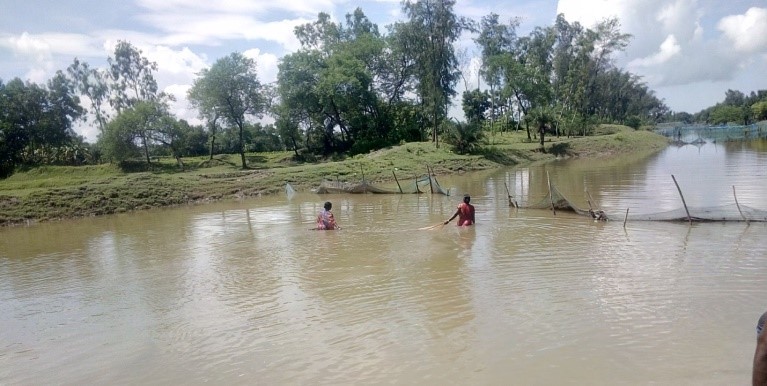 Research Institute took an initiative for the canal fisheries development by a degree of management and technological interventions in different canals of Sunderbans. The ecological status of the selected canals (Bhetkimari, Bishalakhi, Bharua) was studied to assess the fish production potential and productivity. Keeping view of the scientific utilization of these resources from fisheries perspectives, CIFRI initiated the ‘net partition systems for carp polyculture’ in selected canals (Bishalakhi and Bharua canal), where the stocked Indian Major Carps resulted into good growth. It was practised with a participatory mode with the local fish farmers living around the canal, where a group were formed for their support to carry out the culture activities during the experiment. The technology built the capacity and motivated the fishers to take up the underutilized canals for fish culture and enhanced their employment and income.